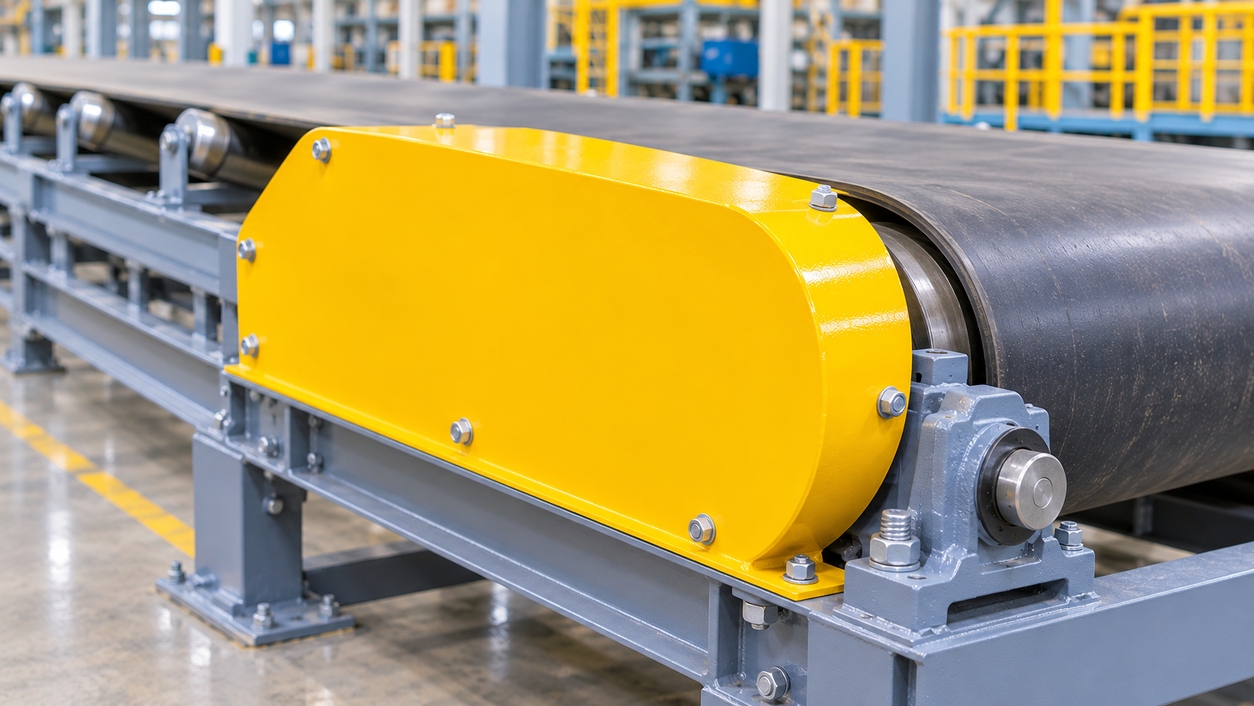
A nip point is a gap where a moving part meets another moving or fixed part and can pinch, crush or pull in a hand, sleeve or hair. On conveyors, nip points are found at pulleys, rollers, drives, transfer points and where the belt runs close to the frame.
- The most serious conveyor injuries come from contact with in-running nips at pulleys and rollers.
- Guard the whole conveyor, not just the head pulley: tail pulley, return rollers, drives and transfer points count too.
- If people need access more than once a shift, use interlocked guards or gates.
- Never clean or clear a conveyor that is running.
What is a conveyor nip point?
A nip point, also called a pinch point or in-running nip, is where two surfaces move towards each other, or one moves towards a fixed surface, and trap anything between them. On a belt conveyor the belt runs onto a pulley; on a roller or chain conveyor, rollers, sprockets and chains draw material in. A hand, glove, sleeve or hair can be pulled in faster than anyone can react.
Where nip points occur on a conveyor
WorkSafe New Zealand’s conveyor guarding guidance identifies these hazard areas on conveyors:
| Location | Why it is a hazard | Typical protection |
|---|---|---|
| Head pulley (discharge end) | In-running nip between belt and pulley | Rigid guards that stop reaching in from any angle, including underneath |
| Tail pulley (loading end) | In-running nip on the return run of the belt | Guard between belt and pulley; firm fencing is preferred |
| Idler pulleys and rollers | Nips between the belt and rollers | Fencing or guards along both sides of the conveyor |
| Drive and transmission | Chains, sprockets and projecting shafts can entangle | Enclose with fixed guards |
| Transfer points | Gaps where goods pass between conveyors | Guard the gap; pop-out rollers can relieve trapping where powered conveyors feed idle roller conveyors |
| Belt, frame, cleats and fasteners | Trapping between belt and frame; snagging on cleats and fasteners | Guard the gap and cover parts people can reach |
How to check your conveyor for nip points
- Stop and isolate the conveyor, using your lock-out procedure.
- Walk the full length with the layout drawing in hand.
- Mark every pulley, roller, drive and transfer point that a person can reach.
- Check the gaps between belt, frame, cleats and fasteners.
- Ask how people reach each point: normal work, jam clearing, cleaning or lubrication.
- Choose a guard type for each point and record it in your risk assessment.
Fixed guards, interlocked guards or fencing?
The right type depends on how often people need access. WorkSafe New Zealand’s conveyor guarding guidance says guards secured by bolts that need a tool to open are acceptable only if access is not needed more than once per shift. If access is needed more often, the guards must be interlocked to the power control. Around pulleys, fencing can isolate the hazard completely. Standards such as ISO 13857 set the safety distances that decide how high a guard must be and how large its openings can be.
We make conveyor guards, conveyor safety fencing and conveyor safety gates to match.
Maintenance, cleaning and lubrication
- Do not clean or clear a conveyor unless it is stopped and the interlock or lock-out is in place.
- Use long-handled scrapers, brooms or brushes to clean around and under conveyors.
- Where tensioning or lubrication happens while the conveyor moves, let rods and nuts reach beyond the guard end or through a small slot, and group lubrication points outside the guards.
Beyond guards: controls that complete the picture
- Stop and start controls, including emergency stops, within reach of the operator.
- Audible and visible warnings before movement when the start position is out of sight.
- No ties, loose clothing or gloves near moving parts.
- Training in the language operators understand.
Getting conveyor guards made
Our conveyor guards are made to your conveyor dimensions in powder-coated mild steel from your drawing, photos or site measurements. Read what is conveyor safety fencing for the wider picture.
We are a Pune-based manufacturer of conveyor safety fencing, conveyor guards and conveyor safety gates, made to your conveyor drawing, photos or site measurements and installed across India. Send your layout to info@conveyorsafetyfencing.com or on WhatsApp for a priced proposal, usually within one working day.
Common questions
What is an in-running nip?
An in-running nip is a gap where a belt, chain or roller runs onto a pulley or sprocket and can draw in a hand, sleeve or hair.
Which conveyor parts need guarding?
Any moving part people can reach, especially head and tail pulleys, idler pulleys and return rollers, drives and projecting shafts, transfer points, and gaps between the belt and frame. Your risk assessment confirms which points need guards.
Do idler rollers need guards?
Where a person can reach an in-running nip at an idler pulley or roller, it needs protection. Guidance such as WorkSafe New Zealand’s suggests fencing between the belt and the idler pulleys on both sides of the conveyor.
Can I clean a conveyor while it is running?
No. Clean or clear a conveyor only when it is stopped and interlock or lock-out systems are in place. Use long-handled tools to clean around and under it.
Can you make guards for my existing conveyor?
Yes. We make guards from your drawing, photos or site measurements so they fit your conveyor.
Send your conveyor layout to info@conveyorsafetyfencing.com or on WhatsApp. See our conveyor safety fencing, conveyor guards and conveyor safety gates.
Keep reading: